

Solo travel has always required a certain kind of resourcefulness. You are the photographer, the navigator, the decision-maker, and the one keeping an eye on your surroundings all at the same time. For solo travelers who also document their trips, whether for a blog, social media, or simply a personal record they actually want to watch back, that list of roles gets longer.
The global solo travel market was worth USD 482.5 billion in 2024, and women make up 84% of solo travellers globally, reflecting how mainstream independent travel has become, particularly among women.
Despite that growth, 21% of solo female travellers have feared for their safety during a solo trip in the last 12 months, which means the safety conversation is not one to skip when thinking about what to pack.
The gear that earns a permanent spot in a solo traveler’s pack tends to be the gear that covers more than one of those roles at once. The five things below have become consistent fixtures in the kits of frequent solo travelers for exactly that reason: they solve real problems without adding weight, bulk, or complexity to a trip that is already being managed by one person.
Smart Glasses for Hands-Free Capture and Situational Awareness
CONTENTS
The tension between documenting a trip and staying aware of your surroundings is one of the more specific challenges of solo travel. Pulling out a phone in an unfamiliar place draws attention, signals that you might be distracted, and creates a moment of reduced awareness at exactly the point where awareness matters most.
Smart glasses address this from both directions simultaneously. The camera captures what you are looking at from eye level without requiring you to hold anything or look down at a screen, which means your head stays up and your eyes stay on the street.

The open-ear audio means you can listen to navigation directions or take a call without blocking out the sounds around you. For solo travelers who also create content, the footage that comes from a day spent wearing camera glasses is consistently more honest and more varied than anything assembled from deliberate phone shots, because it captures the walk through the neighborhood, the market, the train station, the moments between the planned stops that turn out to be the most interesting footage to watch back.
Frequent solo travelers who have explored the current generation of recording glasses tend to note that the frames look nothing like the self-conscious tech eyewear of a few years ago, which matters both socially and practically when moving through places where drawing attention is not in your interest.
A Personal Safety Alarm
A personal safety alarm is one of the lightest and most practical safety items a solo traveler can carry, and one of the most underused. A small device that emits a loud alarm when activated, typically around 120 to 130 decibels, does several things at once: it draws immediate attention to your location, it startles and disorients anyone in close proximity, and it signals to anyone nearby that something is wrong.
According to the 2026 Solo Female Travel Trends survey from Solo Female Travelers, which is the largest global research study on solo female travel statistics and behaviors, experienced female travelers consistently carry more safety tools and use anti-theft bags more often than less experienced travelers, reflecting how practical safety habits develop alongside confidence rather than replacing it.

For solo female travelers in particular, having a safety alarm clipped to a bag strap or kept in an outer pocket means it is accessible without searching, which is the only version of a safety tool that is actually useful in a moment of genuine stress.
The current generation of personal alarms is small enough to sit on a keychain, waterproof enough to survive rain and sweat, and some models also double as a torch, which is a practical addition for navigating poorly lit streets or accommodation at night.
Carrying one is not about expecting the worst. It is about moving through unfamiliar places with one less thing to worry about.
A Portable Charger With Enough Capacity for a Full Day
A dead phone on a solo trip is not just an inconvenience. It removes access to maps, translation, emergency contacts, accommodation details, and every other piece of practical information that lives on a device. 33% of travelers report experiencing crime abroad, and in most of those situations a functioning phone is the first line of response, which makes keeping it charged a safety consideration rather than just a convenience one.

A portable charger with enough capacity to fully charge a phone at least twice covers the realistic demands of a full travel day without requiring access to a power point at a specific time. The models worth carrying are the ones slim enough to fit in a jacket pocket rather than a bag, because the jacket pocket version is the one that gets used rather than left behind.
Fast charging capability matters more than capacity above a certain point, since being able to top up a phone in twenty minutes during a coffee stop is more practically useful than carrying a heavier bank with more total capacity.
For travelers who also carry smart glasses, a wireless charging case is worth factoring into the setup, since managing multiple cables in a small bag across a long travel day adds friction that accumulates over time.
A Compact Offline Navigation Solution
Phone data is not reliable across all the environments solo travelers end up in, and relying on a data connection for navigation in an unfamiliar place creates a single point of failure at exactly the moment when failure is most costly.
Downloading offline maps before leaving accommodation covers the most common version of this problem, but a dedicated compact GPS device goes further by providing navigation that is entirely independent of a phone and its battery.
For travelers heading into areas with limited connectivity, remote hiking routes, rural regions, or destinations where local SIM cards are difficult to obtain, a GPS device that holds detailed maps locally and runs for days on a single charge is a more reliable solution than any phone-based alternative.
Online searches for solo travel increased by 72.6% from April 2023 to April 2024, which reflects how many more people are navigating unfamiliar destinations independently for the first time, making reliable offline navigation more relevant than ever.
The navigation question is also a safety question for solo travelers: knowing where you are and where you are going reduces the need to stop and consult a screen in public, which reduces the signals that invite unwanted attention in unfamiliar environments.
A Well-Chosen Day Bag With Considered Security Features
The bag a solo traveler carries through a day in an unfamiliar city affects almost everything about how that day goes. A bag that is easy to open from behind, sits awkwardly on the body, or requires rummaging to find anything creates small friction points that compound over a full day of navigation, payments, and document checks.
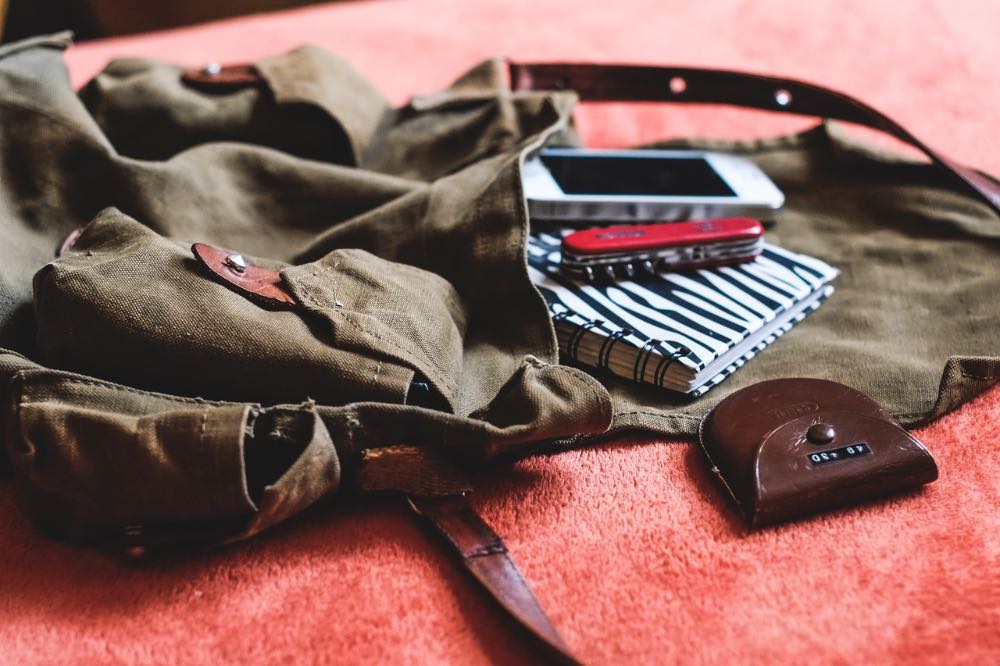
The security features worth prioritising are lockable zippers on main compartments, a hidden pocket against the back panel for documents and cards, and RFID-blocking material in at least one internal pocket to protect contactless payment cards and passport chips.
Weight distribution matters too: a bag that sits close to the body and distributes weight evenly is less tiring to carry for several hours and less likely to pull awkwardly when moving quickly.
76% of women travelers say they would feel unsafe on holiday by themselves, and while experience and preparation reduce that significantly, a bag designed with security in mind is one of the most practical ways to reduce both the risk and the feeling of vulnerability in a new place.
For solo travelers who also carry camera equipment, a bag with a dedicated padded sleeve for a tablet or laptop doubles as protection for any larger recording devices and keeps the kit organized without requiring a separate camera bag.
Conclusion
The through-line across all five of these items is the same one that runs through a good solo travel kit generally: each one reduces a specific friction or risk without adding meaningfully to what you are carrying.
Smart glasses that capture footage without compromising awareness, a safety alarm that weighs almost nothing and costs very little, a portable charger that keeps everything running, an offline navigation solution that works when data does not, and a secure day bag that organizes everything without slowing you down: together these five things cover the content and safety demands of a solo trip more completely than any larger or more complicated setup.
Solo travel is already being managed by one person. The gear that earns its place is the gear that makes that job quieter rather than louder.

- 5 Things Frequent Solo Travelers Pack for Content and Safety - August 6, 2026
- Why the Philippines is Becoming the iGaming Hub of Asia - May 24, 2026
- Cultural Immersion: Guided Paths into the Heart of a Destination - December 18, 2025